Conceptual Brainstorm
The reason I have chosen to go with the topic of Medically Supervised Injecting Centres (MSIC) for my website proposal is because, after doing some research, I have recognised my growing fascination in the way in which they operate and their positive impacts on sufferers of drug addiction. In order to gain inspiration on how I will approach this concept through the format of an online web documentary, I looked into the interactive web documentaries that we investigated in class for the preparation of A1. The projects that stuck with me were ‘Soldier Brother’ (2011) and ‘The Block’ (2010). I was particularly interested in their visual and navigational design as they apply interactivity through clicking on objects that connect the viewer to informative links. While seemingly minimalistic, this design feature enables user interactivity and a refined concept that flows throughout the entire project.
The projected web documentary will be titled ‘The Main-line’. This is a directed reference to ‘Mainlining’ which is the act of a person injecting a drug intravenously. However, the title is a play on words as it also seeks to allude to the website being the main platform for information and support for sufferers of drug addiction.
Synopsis
‘The Main-line’ is an interactive online documentary that enables the user to see the world through the lens of an addicted intravenous drug user. The website aims to educate people on the existence and benefits of MSIC’s as well as create awareness of the dangers of publicly administering drugs. The website also provides links to further external support and information.
Background Context and Research
Medically supervised injecting centres are designated places where people with drug addictions can administer drugs in a safe environment, under the supervision of medical staff and health professionals. The primary aim of a medically supervised injecting centre (MSIC) is not to encourage the use of drugs, but to acknowledge that it is a growing issue of society. It recognises that drug dependence is chronic, with relapse being an in-built part of this. The aim of MSIC’s are to tackle health risks associated with using drugs on the street by introducing drug users to free of charge services and support. While intravenous drug use has been a major societal issue, MSIC facilities are only now becoming a positively recognised resource. With many facilities featured around the world, Australia has recently taken part in MSIC benefit trials, acknowledging the many benefits they provide. The recently opened facility in Kings Cross (Sydney) is now providing users with a safe environment for administering drugs.
Kings Cross
In the 1990s there was an increasing number of businesses in Kings cross in Sydney illegally renting rooms for the purpose of injecting illicit drugs. In 1999, Kings Cross is reported as having the highest concentration of people dying from drug overdose in Australia. After growing concern in the community and subsequent requests by the NSW Government, on 6 May 2001, the Uniting Church Australia opened Australia’s first medically supervised injecting centre (MSIC) in the heart of Kings Cross.
Audience
‘The Main-Line’ is an all-inclusive educational resource which provides easily accessible information on MSIC facilities, how they operate and where to access one. Through doing this, ‘The Main-Line’ seeks to emphasise awareness on the safe administration of drugs within a safe environment. While ‘The Main-Line’ website is aimed to assist the demographic of society who are involved and suffering with drug addiction, it too appeals to the friends and family members of those suffering. Additionally, ‘The Main-Line’ will only cater to people with access to a desktop computer or a laptop, this requires them to be digitally literate. This could inadvertently isolate those who do not have the financial means, physical location or skillset to gain access to this technology.
Platform choice
‘The Main-Line’ will be produced as an online documentary website, as I believe this is the most widely accessible platform. Preferably, it would be made compatible for a desktop computer and laptop. Considering my limited technical skills, it will only be accessible online. An online program is also the easiest and most appropriate way to access information through a desktop computer and laptop. The only issue with making the website solely accessible online is that it may limit those users who do not have access to internet.
Interface design
The interface for ‘The Main-Line’ will be seedy and decrepit, filled with eerie noises and visuals, characteristic of a dark alleyway. The visual design aims to allows users to see the world through the lens of an addicted intravenous drug user by replicating a familiar setting that they would have exposure to.
Entrance page mock layout

The entrance page is the most important aspect of the website. As the first point of contact with the user, the entrance page is aimed at enticing viewers’ attention. ‘The Main-Line’ employs a minimalistic design with contrasting colours, along with easy to read and bold writing which will accentuate ease of access. The entrance page will further utilise a single grid layout with a navigation bar located at the bottom of the page. The navigation bar includes the following links which title: About, Help, Resources and Share. ‘The Main-line’ will make use of a monochromatic colour pallet which will emphasise the main context and ideas of the website. The web page will make use of large negative spaces to implicate usability, especially for those with restricted sight. The focus point of the entrance page will display ‘The Main-Line’ across the screen front. A further focus of the entrance page will be a street sign labelled “Enter on Main-Line Lane”, which will be a hyperlink to the homepage.
Home page mock layout

The users journey on the home page will begin with an animated VR and audio clip. In order to evoke an emotional response, the viewer will experience this video from a first- person perspective. Encompassed in this video will be the sound of a person’s fast-paced heartbeat and heavy shortened breath as they gradually struggle toward a darkened laneway. This opening clip aims to provoke a sense of unease and trepidation in the viewer. In doing so, the user can experience a glimpse of intravenous drug users grim reality. At the conclusion of the VR and audio clip, the screen will slowly fade away into the homepage.
The colour used in ‘The Main-Line’ is used to stimulate an emotional and empathetic response from the viewer. Thus, ‘The Main-Line’ employs a consistently dark and blunt colour scheme to emphasize the dreary and confronting nature of addicted drug users actuality. The colour palette is minimal and monochromatic. Variations of blacks, greys and deep reds are used which are often associated with negative emotional connotations.
Each icon: a syringe, graffiti on the wall, a young school girl, a pamphlet and a street sign is a link to a page of associated information when clicked on. This allows users to interact with the interface at ease, rather than being bombarded with information at first glance, they have the choice to engage with the websites content at their own pace. For instance, the syringe will link to information on the health hazards of used syringes in public spaces. A second example, is the street sign which, when clicked will detail exactly what a Medically Supervised Injecting Centre is and where to find one. The icons will be brightly coloured with a cartoon styled drawing for easy visibility from the website homepage. Each icon will feature a highlighted ring when a user’s curser is on the image. This will be accompanied by negative space so that each icon is clearly defined. These elements come together to effectively render a user accessible interface. Design correlations can be drawn between ‘The Main-line’ and Soldier Brother as they similarly make great use of negative space and feature objects which link to hyperlinked content.

Eerie music will be played in the background of the home page, which will be complemented by other sound effects. These sound effects, such as yowling cats, bat wings-flapping and ambulance sirens ringing will add to the overall ambience of the project.
Purpose
The project aims to function as a platforms that provides information and assistance to those who suffer from intravenous drug addiction as well as family and friends of sufferers. It also seek to educated the wider public on the benefits of MSIC centres.
Social media integration
Links to social media platforms will be located on the navigation bar under the title ‘Share’, at the bottom of each page. These platforms will include Facebook, Instagram, and Twitter. These social media links give users the option to share the website material with their friends and family.
Social media platforms such as these are a major form of promotion for ‘The Main-Line’. These social media sites will be used to ‘The Main-Line’s’ advantage in order to reach a wider audience and thus expand the influence of the project. In addition to this, ‘The Main-Line’ website will also feature links to its own social media profiles. For example, I will create a Facebook page to allow users to further publicize ‘The Main-Line’ through discussion and interaction with other people on a popular forum.
Structure and Navigation
The documentary will begin with a landing/entrance page. The page will feature a link to begin the online documentary, which can be accessed by clicking on the illustrated street sign. Once clicked, a short introductory video will play. This will fade into the homepage. From here, the users will see a selection of images which they can click on to explore.
The displayed images lead to five separate pages, each revealing relevant information. The images are composed organically within the space to create an authentic feel. The order in which each image is explored does not matter as there is no specific sequence or linear narrative to follow. Whether the user explores one of the images or all of the images, they will equally gain the knowledge that they sought to acquire and come away with a complete user experience. As the user hovers their curser over the images, the objects will enlarge with a surrounding highlighting ring, in order to indicate to the user that they are clickable.
While the website allows users to simply watch the content without any effort required, such as in the visual and audio clip, for the most part of the documentary, the user engages in a rational process of clicking on objects and links to access content. This is contrary to Gavin O’Carroll’s model of cognitive ease. Rather, the user engages with the content in a mechanical way through rigid motions. I have made this design choice as I believe the experience of the website should not be a cathartic and relaxing one, rather, it should get users to thoughtfully engage with the information.
Wireframe
Feasibility
I conclude that the execution of this project will be feasible and achievable. Firstly, I have chosen to focus on the Kings Cross clinic as it is a local and available resource. Narrowing the scope of the project allows for an in-depth and comprehensive examination. As the Kings Cross MSIC was set up through an acclaimed foundation, the Uniting Church Australia, there is a plethora of resources available online through the Uniting Church website as well as subsequent studies.
In terms of production, I am adequately proficient in illustration, Adobe Photoshop as well as operating a video camera. These are the skills I will be able to provide in the group devised project. The aural component of the project, such as the audio clip and sound effects can either be constructed through voice recordings or downloaded online through the ‘Free Sound’ website. As these design aspects are created first-hand and or legally accessed through a website resource that is specifically open to the public for use, all copy right issues are
Conceptual Brainstorm
The reason I have chosen to go with the topic of Medically Supervised Injecting Centres (MSIC) for my website proposal is because, after doing some research, I have recognised my growing fascination in the way in which they operate and their positive impacts on sufferers of drug addiction. In order to gain inspiration on how I will approach this concept through the format of an online web documentary, I looked into the interactive web documentaries that we investigated in class for the preparation of A1. The projects that stuck with me were ‘Soldier Brother’ (2011) and ‘The Block’ (2010). I was particularly interested in their visual and navigational design as they apply interactivity through clicking on objects that connect the viewer to informative links. While seemingly minimalistic, this design feature enables user interactivity and a refined concept that flows throughout the entire project.
The projected web documentary will be titled ‘The Main-line’. This is a directed reference to ‘Mainlining’ which is the act of a person injecting a drug intravenously. However, the title is a play on words as it also seeks to allude to the website being the main platform for information and support for sufferers of drug addiction.
Synopsis
‘The Main-line’ is an interactive online documentary that enables the user to see the world through the lens of an addicted intravenous drug user. The website aims to educate people on the existence and benefits of MSIC’s as well as create awareness of the dangers of publicly administering drugs. The website also provides links to further external support and information.
Background Context and Research
Medically supervised injecting centres are designated places where people with drug addictions can administer drugs in a safe environment, under the supervision of medical staff and health professionals. The primary aim of a medically supervised injecting centre (MSIC) is not to encourage the use of drugs, but to acknowledge that it is a growing issue of society. It recognises that drug dependence is chronic, with relapse being an in-built part of this. The aim of MSIC’s are to tackle health risks associated with using drugs on the street by introducing drug users to free of charge services and support. While intravenous drug use has been a major societal issue, MSIC facilities are only now becoming a positively recognised resource. With many facilities featured around the world, Australia has recently taken part in MSIC benefit trials, acknowledging the many benefits they provide. The
recently opened facility in Kings Cross (Sydney) is now providing users with a safe environment for administering drugs.
Kings Cross
In the 1990s there was an increasing number of businesses in Kings cross in Sydney illegally renting rooms for the purpose of injecting illicit drugs. In 1999, Kings Cross is reported as having the highest concentration of people dying from drug overdose in Australia. After growing concern in the community and subsequent requests by the NSW Government, on 6 May 2001, the Uniting Church Australia opened Australia’s first medically supervised injecting centre (MSIC) in the heart of Kings Cross.
Audience
‘The Main-Line’ is an all-inclusive educational resource which provides easily accessible information on MSIC facilities, how they operate and where to access one. Through doing this, ‘The Main-Line’ seeks to emphasise awareness on the safe administration of drugs within a safe environment. While ‘The Main-Line’ website is aimed to assist the demographic of society who are involved and suffering with drug addiction, it too appeals to the friends and family members of those suffering. Additionally, ‘The Main-Line’ will only cater to people with access to a desktop computer or a laptop, this requires them to be digitally literate. This could inadvertently isolate those who do not have the financial means, physical location or skillset to gain access to this technology.
Platform choice
‘The Main-Line’ will be produced as an online documentary website, as I believe this is the most widely accessible platform. Preferably, it would be made compatible for a desktop computer and laptop. Considering my limited technical skills, it will only be accessible online. An online program is also the easiest and most appropriate way to access information through a desktop computer and laptop. The only issue with making the website solely accessible online is that it may limit those users who do not have access to internet.
Interface design
The interface for ‘The Main-Line’ will be seedy and decrepit, filled with eerie noises and visuals, characteristic of a dark alleyway. The visual design aims to allows users to see the world through the lens of an addicted intravenous drug user by replicating a familiar setting that they would have exposure to.
Entrance page mock layout
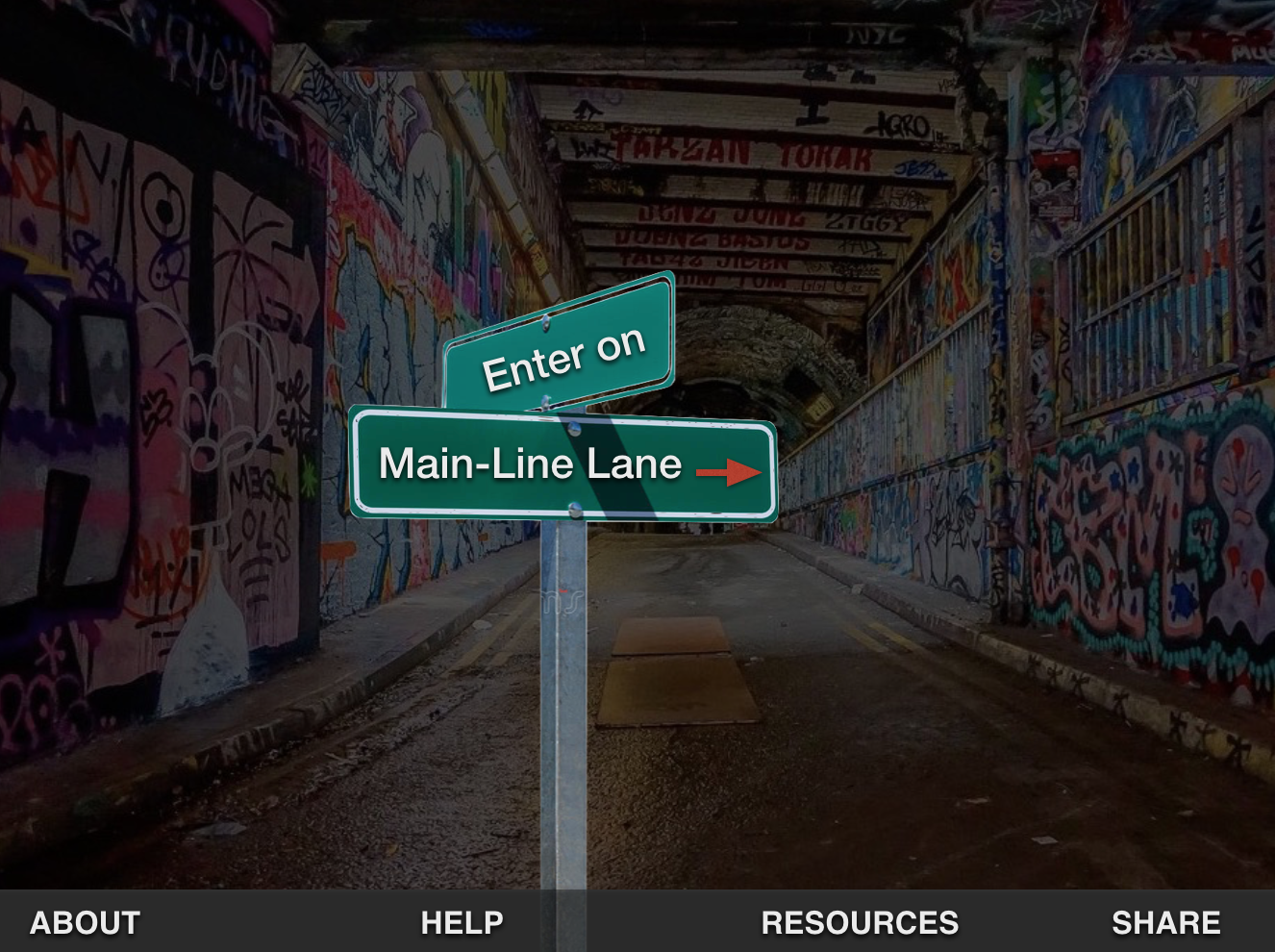
The entrance page is the most important aspect of the website. As the first point of contact with the user, the entrance page is aimed at enticing viewers’ attention. ‘The Main-Line’ employs a minimalistic design with contrasting colours, along with easy to read and bold writing which will accentuate ease of access. The entrance page will further utilise a single grid layout with a navigation bar located at the bottom of the page. The navigation bar includes the following links which title: About, Help, Resources and Share. ‘The Main-line’ will make use of a monochromatic colour pallet which will emphasise the main context and ideas of the website. The web page will make use of large negative spaces to implicate usability, especially for those with restricted sight. The focus point of the entrance page will display ‘The Main-Line’ across the screen front. A further focus of the entrance page will be a street sign labelled “Enter on Main-Line Lane”, which will be a hyperlink to the homepage.
Home page mock layout
The users journey on the home page will begin with an animated VR and audio clip. In order to evoke an emotional response, the viewer will experience this video from a first- person perspective. Encompassed in this video will be the sound of a person’s fast-paced heartbeat and heavy shortened breath as they gradually struggle toward a darkened laneway. This opening clip aims to provoke a sense of unease and trepidation in the viewer. In doing so, the user can experience a glimpse of intravenous drug users grim reality. At the conclusion of the VR and audio clip, the screen will slowly fade away into the homepage.
The colour used in ‘The Main-Line’ is used to stimulate an emotional and empathetic response from the viewer. Thus, ‘The Main-Line’ employs a consistently dark and blunt colour scheme to emphasize the dreary and confronting nature of addicted drug users actuality. The colour palette is minimal and monochromatic. Variations of blacks, greys and deep reds are used which are often associated with negative emotional connotations.
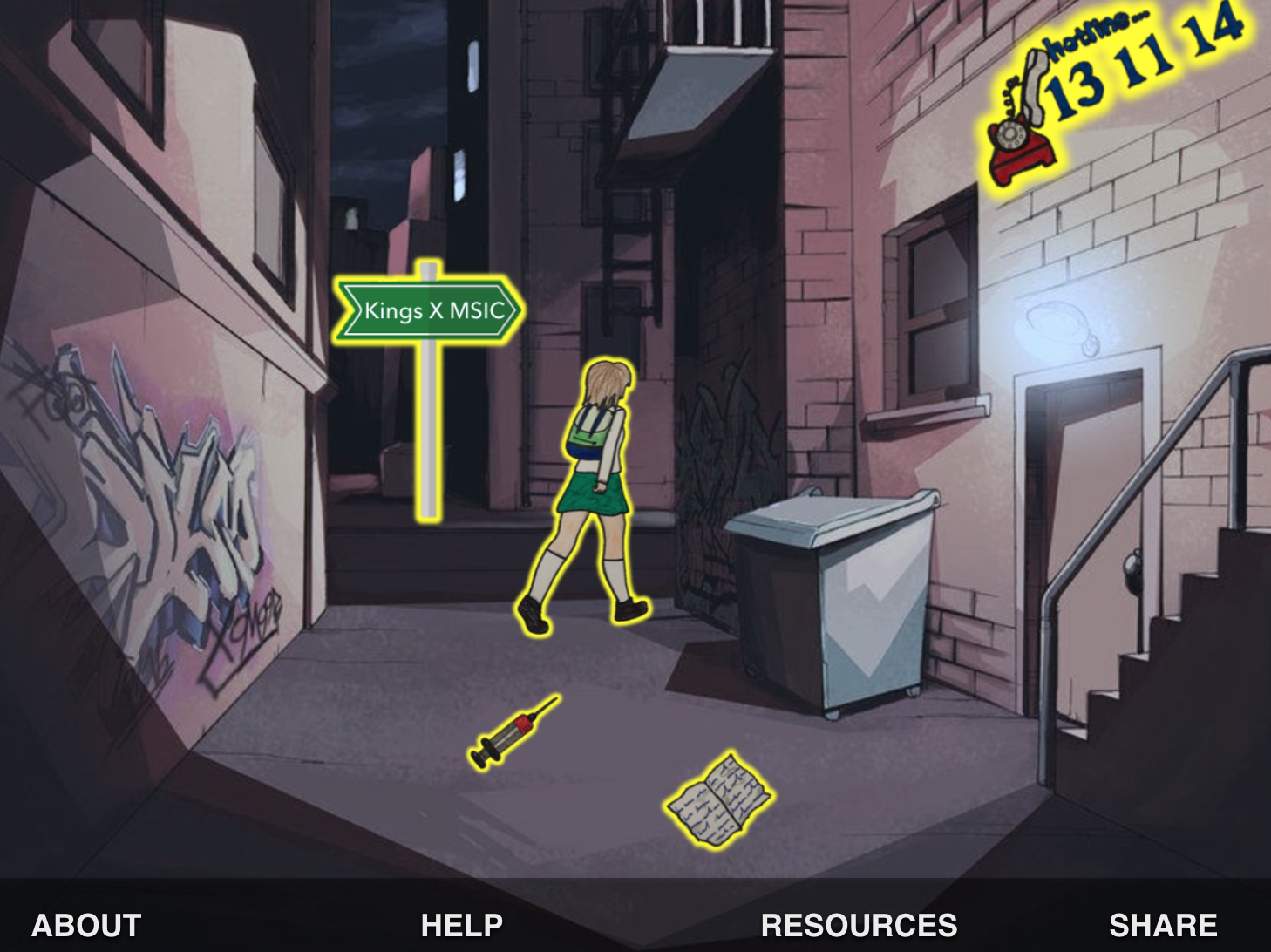
Each icon: a syringe, graffiti on the wall, a young school girl, a pamphlet and a street sign is a link to a page of associated information when clicked on. This allows users to interact with the interface at ease, rather than being bombarded with information at first glance, they have the choice to engage with the websites content at their own pace. For instance, the syringe will link to information on the health hazards of used syringes in public spaces. A second example, is the street sign which, when clicked will detail exactly what a Medically Supervised Injecting Centre is and where to find one. The icons will be brightly coloured with a cartoon styled drawing for easy visibility from the website homepage. Each icon will feature a highlighted ring when a user’s curser is on the image. This will be accompanied by negative space so that each icon is clearly defined. These elements come together to effectively render a user accessible interface. Design correlations can be drawn between ‘The Main-line’ and Soldier Brother as they similarly make great use of negative space and feature objects which link to hyperlinked content.
Hand drawn mock-up of Icons:

Eerie music will be played in the background of the home page, which will be complemented by other sound effects. These sound effects, such as yowling cats, bat wings-flapping and ambulance sirens ringing will add to the overall ambience of the project.
Purpose
The project aims to function as a platforms that provides information and assistance to those who suffer from intravenous drug addiction as well as family and friends of sufferers. It also seek to educated the wider public on the benefits of MSIC centres.
Social media integration
Links to social media platforms will be located on the navigation bar under the title ‘Share’, at the bottom of each page. These platforms will include Facebook, Instagram, and Twitter. These social media links give users the option to share the website material with their friends and family. Social media platforms such as these are a major form of promotion for ‘The Main-Line’. These social media sites will be used to ‘The Main-Line’s’ advantage in order to reach a wider audience and thus expand the influence of the project. In addition to this, ‘The Main-Line’ website will also feature links to its own social media profiles. For example, I will create a Facebook page to allow users to further publicize ‘The Main-Line’ through discussion and interaction with other people on a popular forum.
Structure and Navigation
Wireframe

The documentary will begin with a landing/entrance page. The page will feature a link to begin the online documentary, which can be accessed by clicking on the illustrated street sign. Once clicked, a short introductory video will play. This will fade into the homepage. From here, the users will see a selection of images which they can click on to explore.
The displayed images lead to five separate pages, each revealing relevant information. The images are composed organically within the space to create an authentic feel. The order in which each image is explored does not matter as there is no specific sequence or linear narrative to follow. Whether the user explores one of the images or all of the images, they will equally gain the knowledge that they sought to acquire and come away with a complete user experience. As the user hovers their curser over the images, the objects will enlarge with a surrounding highlighting ring, in order to indicate to the user that they are clickable.
While the website allows users to simply watch the content without any effort required, such as in the visual and audio clip, for the most part of the documentary, the user engages in a rational process of clicking on objects and links to access content. This is contrary to Gavin O’Carroll’s model of cognitive ease. Rather, the user engages with the content in a mechanical way through rigid motions. I have made this design choice as I believe the experience of the website should not be a cathartic and relaxing one, rather, it should get users to thoughtfully engage with the information.
Feasibility
I conclude that the execution of this project will be feasible and achievable. Firstly, I have chosen to focus on the Kings Cross clinic as it is a local and available resource. Narrowing the scope of the project allows for an in-depth and comprehensive examination. As the Kings Cross MSIC was set up through an acclaimed foundation, Uniting Australia, there is a plethora of resources available online through the Uniting website as well as subsequent studies.
In terms of production, I am adequately proficient in illustration, Adobe Photoshop as well as operating a video camera. These are the skills I will be able to provide in the group devised project. The aural component of the project, such as the audio clip and sound effects can either be constructed through voice recordings or downloaded online through the ‘Free Sound’ website. As these design aspects are created first-hand and or legally accessed through a website resource that is specifically open to the public for use, all copy right issues are eliminated.
References
Marianne Jauncey 2017, What goes on inside a medically supervised injection facility?, The Conversation, UNSW, viewed 1 May 2019,
https://www.abc.net.au/news/2017-11-29/what-goes-on-in-medically-supervised-injection-room/9205778
Uniting, Medically Supervised Injecting Centre, viewed 26 April 2019,
https://uniting.org/who-we-help/for-adults/sydney-medically-supervised-injecting-centre/our-story
ADF 2017, Medically supervised injecting centres, Sydney, viewed 25 April 2019, https://adf.org.au/insights/medically-supervised-injecting-centres/
Kaitlin Jones 2011, Soldier Brother, Canada, viewed 10 May 2019, http://soldierbrother.nfb.ca
The Block 2010, Stories from a Meeting Place, SBS,Sydney, viewed 10 May 2019,
.

 Gabby's Blog